
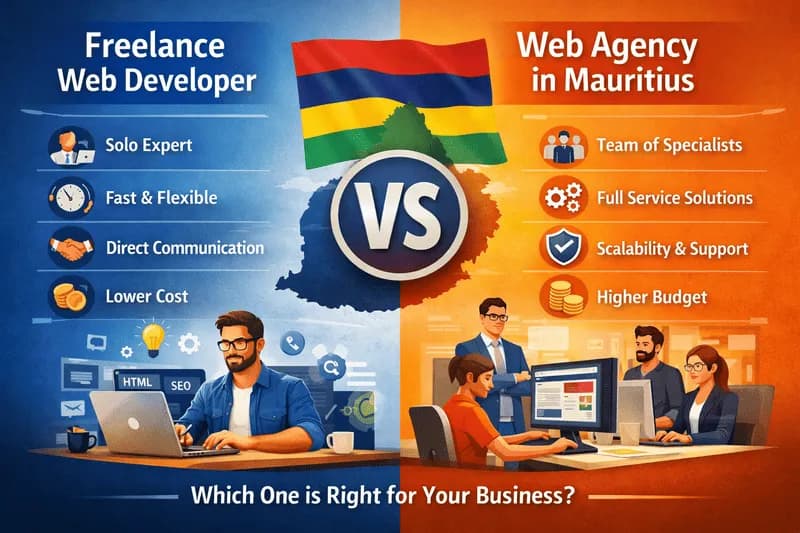
If you’re building or rebuilding a website in Mauritius in 2026, you’ll probably face this question early: Do I hire a freelance web developer or a web agency?
And it’s not a small decision. The wrong pick can cost you time, money, and momentum—especially if you’re trying to launch quickly, rank on Google, or connect your site to real business workflows (leads, bookings, payments, inventory, CRM, etc.).
The truth is: both can be great, and both can be risky. What matters is how they work, what you actually need, and whether the person/team you hire matches the complexity of your project.
Let’s break it down in a way that’s practical for Mauritius (and still relevant if you serve international customers too).
1) What you’re really buying (it’s not “a website”)
Most people think they’re paying for pages. In reality, you’re paying for a mix of:
- Discovery & strategy (what the site must do, and for who)
- UX/UI decisions (navigation, structure, clarity, conversions)
- Build quality (performance, security, clean code, scalability)
- Content support (copywriting guidance, images, translations)
- SEO foundations (technical SEO, metadata, speed, schema)
- Integration (forms, WhatsApp click-to-chat, CRM, payments, booking, etc.)
- Launch & maintenance (hosting, backups, updates, monitoring)
A freelancer or agency can deliver all of that—but not always at the same depth, and not always with the same process.
2) The core difference: “one brain” vs “many brains”
Freelancer
Usually one person handles most tasks: planning, design help, development, deployment, fixes, and sometimes content/SEO setup.
Agency
A small team splits work: project manager, designer, developer(s), SEO/content, QA, support.
This is the trade-off:
- Freelancers often move faster with fewer meetings.
- Agencies can cover more specialties at once (but with more coordination).
3) Cost in Mauritius: why the range is so wide
In Mauritius, you’ll see quotes that vary massively. That doesn’t automatically mean someone is “overcharging” or “cheap = bad.” It usually means the scope isn’t the same.
A cheaper offer often includes:
- A template-based site
- Minimal SEO
- Shared hosting setup (sometimes unmanaged)
- Basic contact form only
- Little/no performance work
- Little/no long-term support
A higher quote often includes:
- Custom design and structure based on your business goals
- Better performance and security work
- Proper staging + QA testing
- SEO foundations (not “magic SEO”, but strong technical setup)
- Support plan / maintenance / monitoring
- Integrations (booking, payments, CRM, automations)
If you want to mention budget on your site, a safe way (without promising fixed prices) is to say something like:
“Projects can range from tens of thousands of MUR to significantly more depending on scope, integrations, and ongoing support.”
4) When a freelance web developer is the best choice
A freelancer is often a strong fit when you need:
Speed + direct communication
You speak to the person who builds the site. Decisions are faster. Fewer “handoffs.”
A focused project with a clear scope
Examples:
- A professional brochure website
- A landing page for ads
- A portfolio or small business site
- A bilingual EN/FR website with standard sections
- A redesign focused on speed + SEO clean-up
Flexibility
Freelancers can adapt quickly when you change priorities—especially for small-to-mid builds.
Long-term relationship
Many Mauritian businesses prefer having “their person” they can message when something needs updating.
Watch-outs (be honest about these):
- If the freelancer gets sick, travels, or is overloaded, delivery can slow down.
- Not every freelancer is strong in design, SEO, or complex back-end logic.
- Some freelancers don’t document well (which becomes a pain later).
Green flags for a freelancer:
- Clear proposal + deliverables
- A simple timeline with milestones
- A contract that states ownership and access
- A maintenance option (even if you don’t take it)
- Shows real work: live links, not only screenshots
5) When a web agency is the best choice
An agency can be a strong fit when you need:
A lot happening at once
Examples:
- Brand + website + content + SEO together
- E-commerce with product structure, payments, delivery logic
- Booking systems with calendars, deposits, automated emails
- Web apps or portals (client login, dashboards, internal tools)
Reliability through capacity
If one team member is unavailable, another can continue.
Specialized roles
A good agency has people who really focus on UI, SEO, copy, or QA—not “one person doing everything.”
Ongoing support / SLAs
For businesses that can’t afford downtime, agencies often offer structured support packages.
Watch-outs:
- More meetings, more process (which can slow simple projects)
- Sometimes you’re sold by a senior person and delivered by juniors
- Some agencies lock clients into subscriptions without clear ownership or exit plan
Green flags for an agency:
- They show who is on the team and what each person does
- They explain their process: discovery → design → build → QA → launch
- They provide staging links, testing steps, and documentation
- They don’t avoid technical questions (hosting, backups, security, performance)
6) The biggest “hidden cost” isn’t the build—it's what happens after launch
In 2026, websites aren’t “set and forget.” Tech updates, browser changes, plugin updates, security patches, performance improvements—these are normal.
Common hidden costs (and why they matter):
- Domain renewal (yourname.mu or .com)
- Hosting (shared vs VPS vs managed hosting)
- Email (professional inboxes, deliverability)
- Backups & monitoring (especially if the site generates leads/sales)
- Maintenance (updates, bug fixes, security)
- Content updates (new pages, new offers, new photos)
- SEO (ongoing content + local SEO is a long game)
A cheap build can become expensive if:
- It loads slowly (lost leads)
- It breaks often (panic fixes)
- It’s hard to update (you pay for every tiny change)
- It has weak security (cleanup costs + reputation damage)
7) Shared hosting vs VPS: why “cheap hosting” can hurt your business
In Mauritius, many small businesses start with shared hosting, and that can be okay for a simple site—if it’s configured well and your site isn’t heavy.
But if your site includes:
- lots of images
- animation-heavy pages
- e-commerce
- bookings
- multiple languages with dynamic rendering
- frequent traffic from ads
…then hosting quality becomes part of your marketing. A slow site reduces trust, rankings, and conversions.
The real question isn’t “shared vs VPS.” It’s:
- Are backups running?
- Are updates managed?
- Is the server secure?
- Do you have monitoring and uptime alerts?
- Is caching configured properly?
- Is your site optimized (images, code, fonts)?
A freelancer or agency should be able to explain this in simple language.
8) A simple decision checklist (use this before you sign)
Choose a freelancer if:
- Your project is straightforward
- You want quick turnaround and direct communication
- You value a long-term one-to-one relationship
- You’re okay with a single point of delivery (and you trust them)
Choose an agency if:
- You need multiple skills at once (design + copy + SEO + dev)
- You need higher capacity and structured support
- Your project has many moving parts or integrations
- You want a team that can maintain and scale the platform
Choose a hybrid approach if:
- You want an agency-level design + a freelancer to build
- You want a freelancer lead with specialists added when needed
Hybrid is underrated—and often gives the best of both worlds.
9) The questions most people forget to ask (but should)
Before you hire anyone, ask these:
- Who owns the domain and hosting?
It should be you. Always. - Will I get admin access and all credentials?
Yes. No excuses. - Is the website editable without calling you for every change?
If you want independence, request a CMS or a clear editing system. - What happens if we stop working together?
You should still have your website, files, and access. - What’s included in the quote—and what isn’t?
Ask for a breakdown: pages, features, revisions, content upload, SEO basics, performance, training, maintenance. - How do you handle bugs after launch?
Is there a warranty period? What’s the response time? - Can you show me similar projects and results?
Not “promises,” but real examples.
10) Red flags (freelancer or agency)
- No written scope (only WhatsApp promises)
- They avoid timelines (“we’ll see”)
- They can’t explain hosting/security basics
- They refuse to give access credentials
- They push you to pay everything upfront without milestones
- They claim “#1 on Google guaranteed”
- They reuse the same template for everyone without adapting structure/content
Final thought
A freelancer isn’t automatically better than an agency, and an agency isn’t automatically more “professional” than a freelancer.
The best choice in Mauritius in 2026 is the one that matches:
- your scope,
- your timeline,
- your need for support,
- and the quality/process of the person/team you hire.
If you want it simple:
Choose the people who ask the best questions before they ever start building. That’s usually where the good projects begin.